

Why Crisis Simulation Exercises Are No Longer Optional – They’re Business Imperatives
January 12, 2026Why Crisis Simulation Exercises Are No Longer Optional – They’re Business Imperatives
January 12, 2026Insights
From Search to Conversation: Why AI GEO Now Matters
For years, digital visibility was built around a familiar question:
How do we rank higher in search?
That question still matters. But it is no longer enough.
People are increasingly using AI assistants to research companies, compare options, assess credibility and make decisions. Instead of typing one query and opening a list of links, they are asking a sequence of questions:
- Which company should I consider?
- Which one is more trusted? What are the risks?
- How do the options compare?
- Which provider is right for my needs?
This changes the discovery journey.
A company may appear in the first answer, then disappear as the conversation becomes more specific. It may be mentioned inaccurately, described using outdated information, or replaced by a competitor when the user asks for proof, comparison or recommendation.
That is where AI GEO comes in.
What is AI GEO?
GEO stands for Generative Engine Optimisation.
It is the process of improving how a company is understood, represented and surfaced by AI systems such as ChatGPT, Gemini, Copilot, Perplexity and other AI-powered discovery tools.
Traditional SEO focuses on helping websites rank in search results.
GEO is broader.
It looks at whether AI systems can:
- find your company;
- understand what it does;
- describe it accurately;
- identify credible sources about it;
- compare it fairly with competitors;
- cite it in relevant answers;
- continue to surface it as the conversation develops.
The question is no longer only:
Can people find us?
It is:
Do we remain part of the decision?
Why GEO matters
AI is already becoming part of how consumers research products, services and companies.
Our Cambodia AI Usage and Behaviour study found that 75% of engaged respondents use AI to help choose products, services or companies. The same research also showed that people do not rely on AI alone. Most continue to verify what they find through websites, Facebook, TikTok, reviews, news and other public sources.
This means AI visibility cannot be separated from the wider communications and reputation ecosystem.
AI systems draw from the information available to them. That can include:
- company websites;
- media coverage;
- reviews;
- directory listings;
- social content;
- executive profiles;
- public reports;
- structured data;
- third-party commentary.
If that information is unclear, inconsistent, weak or outdated, AI answers may reflect those gaps.
The risk is not only that your company fails to appear.
AI may:
- describe your company incorrectly;
- rely on old information;
- overlook important services or credentials;
- surface negative information without context;
- position a competitor as the stronger or more credible option;
- mention your company initially, then drop it from later comparisons.
For sectors such as banking, insurance, healthcare, hospitality and professional services, this is not simply a marketing issue.
It is a reputation, trust and commercial issue.
AI discovery is conversational
Google’s Southeast Asia research shows that AI use is becoming more frequent and more conversational. Users are returning more often, sending more prompts and holding longer conversations with AI assistants. Younger users are also asking more detailed questions and engaging in longer exchanges.
This matters because first-answer visibility is only part of the picture.
A user may start with:
Which banks should I consider in Cambodia?
Then continue with:
Which are safest?
Which are best for business customers?
Which have the strongest regional reputation?
What are the drawbacks?
Compare the top three.
A company may appear at the start but disappear once the user asks for evidence, trust signals or a more specific recommendation.
That is why GEO needs to measure the full conversation, not just a single prompt.
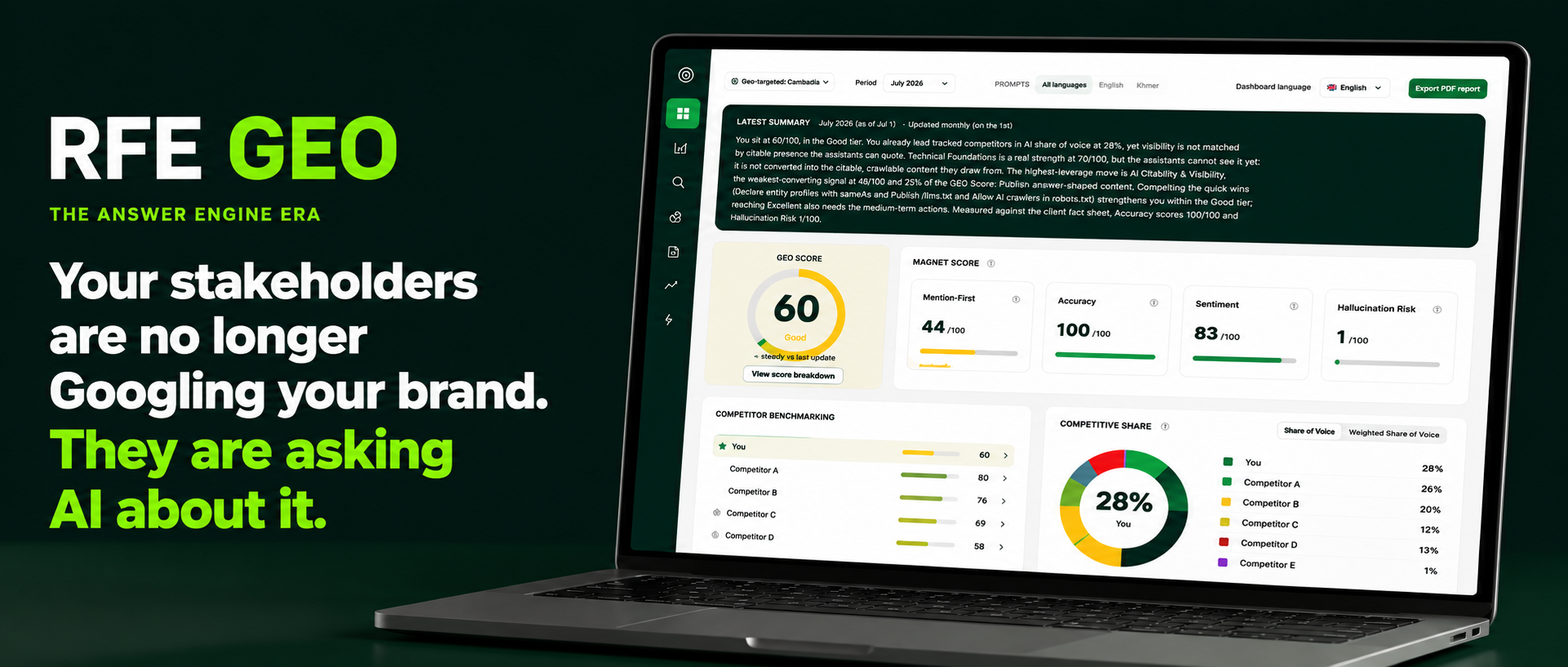
Introducing the RFE GEO dashboard
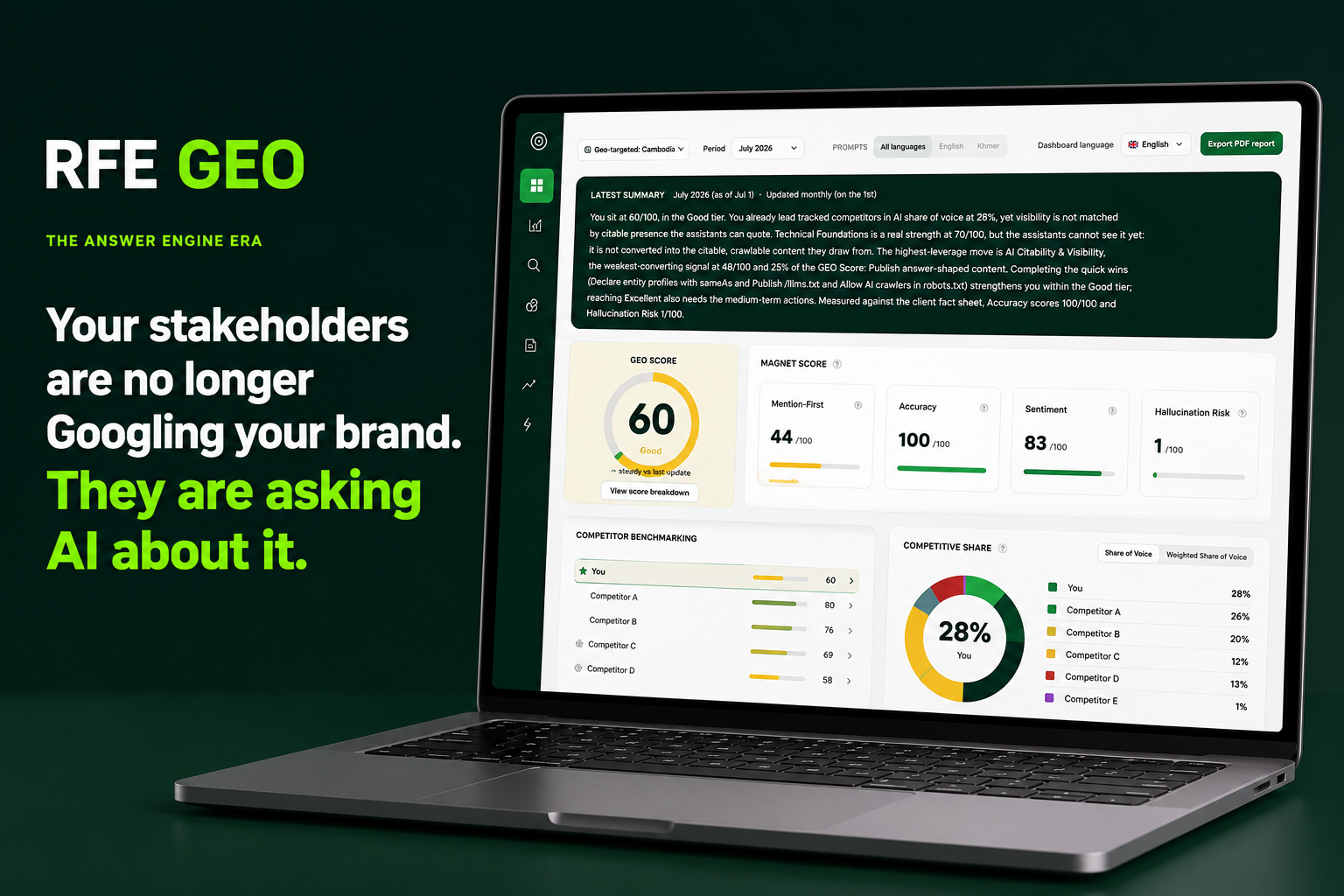
RFE GEO is built to help companies understand and improve how they appear across AI-led discovery.
The platform provides a live dashboard that monitors your GEO performance and shows where the biggest opportunities and risks sit.
It tracks areas including:
GEO score
A clear overall measure of how your company is performing across AI discovery.
Visibility
Whether your company appears in relevant AI answers and how consistently it is surfaced across different prompts.
Accuracy
How correctly AI systems describe your company, services, positioning and key facts.
Sentiment
Whether the company is presented positively, neutrally or cautiously.
Citation strength
Which sources AI systems rely on when forming answers about your company.
Hallucination risk
Where AI may be generating inaccurate, unsupported or misleading information.
Competitive performance
Which competitors are being surfaced instead and where they are outperforming you.
Recommendations
The dashboard does not stop at measurement.
It provides practical recommendations on how to improve your GEO score, including:
- quick technical fixes;
- website and content improvements;
- stronger source signals;
- local-language content opportunities;
- media and authority-building actions;
- reputation gaps that need addressing;
- longer-term strategic priorities.
This gives communications, marketing and leadership teams a clearer view of how their company is being understood by AI, and what they can do about it.
Why this is bigger than SEO
GEO should not be treated as a narrow technical exercise.
It sits across:
- corporate reputation;
- communications;
- content;
- media authority;
- digital visibility;
- structured information;
- local-language presence;
- executive credibility;
- customer trust.
The companies that perform well will not simply be those with the most content.
They will be those that are easiest for AI systems to understand, verify and confidently include.
That requires clarity, consistency and strong public evidence.
Start with a free GEO audit
Most companies do not yet know what AI says about them.
A free GEO audit provides an initial view of:
- whether your company appears in relevant AI answers;
- how accurately it is described;
- which competitors are being surfaced instead;
- which sources are shaping the response;
- where the biggest visibility and reputation gaps sit;
- what actions could improve your GEO performance.
Request a free GEO audit or book a demo of the RFE GEO dashboard to see how your company performs across AI-led discovery.